
Thank you! Your submission has been received!
Oops! Something went wrong while submitting the form.
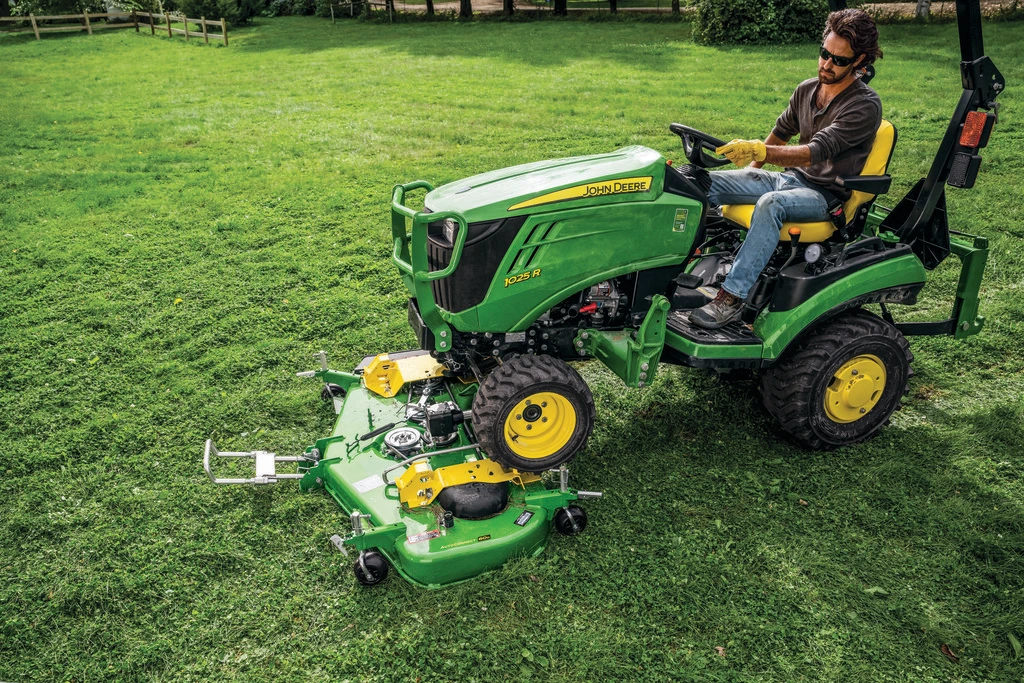
This guide walks through the process of leveling a John Deere mower deck and explains why proper deck setup has such a big impact on cut quality. Streaks, uneven patches, and scalped spots after mowing usually point to one culprit: the mower deck, not the tractor itself.
For owners of a John Deere 1 Series compact tractor, keeping the mower deck properly adjusted is one of the simplest ways to improve cut quality and get more out of every pass. Leveling a deck is a straightforward maintenance task that takes only a few basic tools and a little patience.
Whether you’re caring for a large residential property, maintaining a hobby farm, or keeping clients’ landscapes in good shape, knowing how mower deck adjustment works can save you time and frustration all season long.
A mower deck is the housing mounted beneath the tractor that holds the cutting blades. It sets how wide a path you cut with each pass and manages the airflow that lifts grass for a cleaner, more consistent cut.
Owners of John Deere 1 Series machines typically choose between a John Deere 54-inch mower deck and a John Deere 60-inch mower deck. Both produce excellent results, but neither performs at its best if the deck is out of adjustment.
Many operators first notice a problem when one side of the lawn sits slightly higher than the other. Others see scalping on uneven terrain or end up making multiple passes to get the finish they want. Those symptoms often point straight to deck alignment.
Before checking any measurements, confirm the deck is installed correctly.
John Deere’s AutoConnect system has simplified this considerably. Instead of crawling beneath the tractor to connect driveline components by hand, you can drive directly over the deck and let the system engage on its own.
On a level surface, put the tractor in low range and line it up with the deck ramps. Drive forward slowly until the deck locks into place. Raise the deck fully, confirm all connections are secure, then set the gauge wheels to your desired cutting height.
The John Deere AutoConnect mower deck makes attachment and removal quick, but proper engagement still matters. A deck that isn’t seated correctly can create symptoms that look a lot like a leveling problem.
When customers come into a dealership complaining about an uneven cut, deck level usually gets the blame first. Technicians tend to check a few other things before that.
Tire pressure is one of the biggest culprits. A difference of just a few pounds between tires can change mowing height enough to show up across a lawn. Before touching a single adjustment nut, make sure every tire is inflated to the specifications in your operator’s manual.
Blade condition is another common issue. A bent blade can mimic an out-of-level deck, and dull blades leave grass looking ragged even when the deck is set perfectly.
If cut quality drops suddenly after you hit a root, rock, or stump, check the blades before reaching for a wrench. Service technicians often find that operators spend time adjusting a deck that was properly leveled all along, when the real problem was a slightly bent blade.
The underside of the deck deserves a look too. Heavy grass buildup disrupts airflow and keeps the deck from cutting consistently, especially during periods of rapid growth.
Only after you’ve ruled those out should deck adjustment become the main focus.
It’s one of the first questions new tractor owners ask, and the answer runs counter to what most expect.
A mower deck should not sit perfectly level from front to back.
For the best performance, the front of the blade path should sit slightly lower than the rear. On most John Deere mower decks, the front blade tip should measure roughly 1/8 to 1/4 inch lower than the rear blade tip.
That slight forward pitch does real work. It lets the blade cut the grass cleanly once before passing it through the deck for discharge. If the rear of the deck sits too low, the blade keeps striking the same grass, which raises power demand and leaves a rougher finish.
A properly pitched deck cuts cleaner, discharges clippings more efficiently, and puts less strain on the tractor.
The process is nearly identical whether you’re working with a John Deere 54-inch mower deck or a 60-inch model.
Park the tractor on a hard, level surface. Concrete is ideal. Set the mower to your normal cutting height and make sure the tires are properly inflated.
Some operators use a tape measure; others prefer a mower deck leveling gauge for quicker, more consistent readings.
Rotate the blades so they point left and right across the tractor.
Measure from each outer blade tip to the ground. The two readings should be nearly identical, with no more than about 1/16 inch difference between sides.
If one side sits lower, adjust the lift-link hardware until both sides match. This step is critical, because even a small gap becomes noticeable over multiple passes.
Take your measurements more than once before adjusting anything. A rushed reading often leads to corrections you didn’t need.
Once the deck is level side to side, rotate the blades so they point front to back.
Measure from the front blade tip to the ground, then do the same at the rear blade tip, and compare the two.
The front should land roughly 1/8 to 1/4 inch lower than the rear.
If you need to adjust, find the front draft rod or hanger assembly and make small corrections. Recheck the measurements after each change rather than trying to nail the setting in one move.
One common mistake is adjusting front-to-back pitch and forgetting to recheck side-to-side level afterward. Small changes can shift both measurements, particularly on older equipment.
Measurements get you close, but a quick test pass confirms the result.
After you finish adjusting, mow a small section and inspect it. Look for consistent height, clean clipping discharge, and a smooth appearance across the cut path.
If problems persist, inspect the blades, spindle components, and lift-link hardware before assuming you need more adjustment.
The overall procedure stays the same regardless of deck size, but a few practical differences are worth noting.
A John Deere 54-inch mower deck is lighter and a little easier to maneuver during maintenance. It’s a popular pick for properties with landscaping features, tight turns, and obstacles.
A John Deere 60-inch mower deck covers more ground per pass, which makes it a strong fit for larger properties. Because of that extra width and weight, worn lift components or loose hardware can throw off deck alignment more easily.
When you’re working on a 60-inch deck, recheck the side-to-side measurements after adjusting front-to-back pitch. The added weight can influence the final numbers more than you’d expect.
Regular deck inspections are one of the simplest ways to hold cut quality through the season. Checking tire pressure, inspecting blades, cleaning the underside of the deck, and verifying alignment a few times a year prevents most of the mowing issues owners run into.
If you’re weighing equipment options for a new property or thinking about upgrading your current setup, Ag-Pro carries a full lineup of John Deere compact utility tractors, mower decks, and attachments built to handle everything from weekly lawn care to larger property projects.
Stop by your local Ag-Pro dealership to see the latest John Deere 1 Series compact tractor models, compare deck options, and find the equipment that fits your property and your mowing goals.


